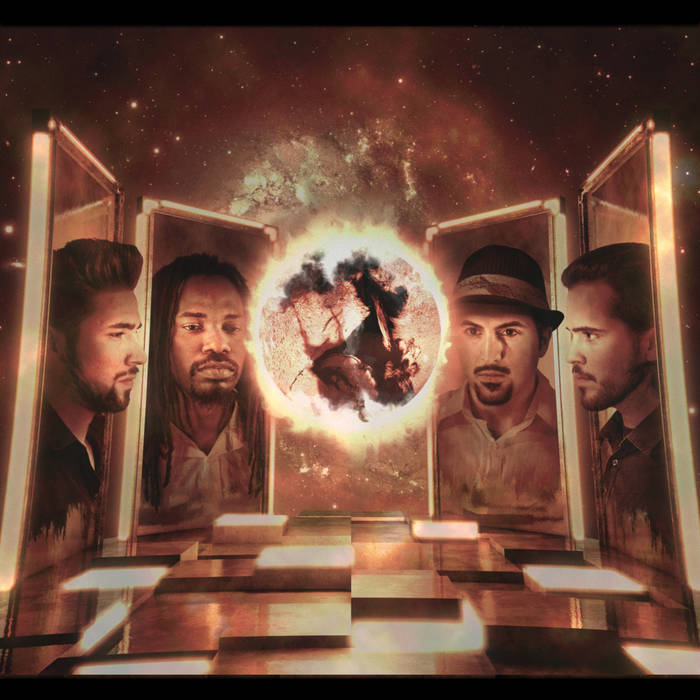
Escape Is Not Freedom are from the US and play Alternative Metal. This is their début EP.
5 songs, 28 minutes.
I like this band. They’re playing a style that’s a bit harder to pigeon hole than most, and I haven’t really heard much too similar to this for a long time.
The band this reminds me the most of is Fudge Tunnel, only with slightly harsher vocals. If you know Fudge Tunnel at all, then it will give you a good idea of Escape Is Not Freedom’s sound. If not, then think slightly-muted and unusual Alternative Metal, done with a Noise Rock background and a raw, underground Grunge influence, before it became a big thing. Add in a few elements of Therapy? at their more Alt-Rock and a pinch of Helmet, and you have this EP.
The songs are a satisfying listen, taking me back to the 90s in many respects. If you’re looking for a few more modern references though, think a less-Sludge version of Kowloon Walled City mixed with a bit of Russian Circles.
The slightly-muted delivery is an interesting one as it is frequently presented by large riffs and energetic guitars, so how they manage to retain that subtlety and understated-edge that Fudge Tunnel did so well is beyond me. It’s partially down to the production, but also the feel of the songs themselves. It’s a very hard-to-achieve juxtaposition, but when done right, it works.
This won’t be to everyone’s tastes, (which is a silly thing to say in many ways, as you could literally say that about any band), but I have enjoyed it; not only due to the fact that it’s a little different, but also just due to the strength of the songs themselves.
If you’re looking for something a little outside of your normal comfort zone, try Escape Is Not Freedom on for size.
This is the début EP from Vision Lunar, a one-man Atmospheric Black Metal project from Canada.
This is minimalistic Black Metal, atmospheric and haunting in its beauty and emanating an aura of darkness that’s softly broken by pale moonlight.
It’s a subtle affair, more interested in setting a scene and encouraging the listener to feel for themselves the primordial power of the night, rather than bluntly stating its intent with crude blasting or ugly vitriol.
The first song leads you in gently, while the last track lets you out slowly. In the middle is the main event; cascading Blackened riffs, producing a veritable sea of darkness that the moon gently glides above.
There are no vocals to sully the purity of this midnight exploration, only the atmospheric mood-setting of the guitars.
It’s a short release; at just under 12 minutes in length it’s a mere introduction to the vision of this particular artist. It’s worth setting aside the time to get to know it though, as its charms are insidious and rich in emotive qualities.
Insanity are a Death Metal band from the US. This is their second album.
Featuring a sharp Old-School sound, Insanity’s brand of Death Metal is from a much older era, harking back to the 80s period. Death are a clear influence, (pre-Progressive Death Metal), and Insanity are equally as sharp in their delivery. Add this to a simpler, more straight-forward Death Metal style, à la early-Deicide, and you have honest songs that hit the spot more often than not.
Shining leads and solos make frequent grabs for the limelight and the drummer keeps a machine-like performance going throughout.
There’s decent variation within their musical framework and the songwriting concentrates on songs first and foremost. The combination of simple riffs with more-complicated solos, leads and guitar parts makes for a compelling listen. There’s also a slight Thrash Metal influence which means that Visions of Apocalypse has a lot to offer the listener.
The singer’s voice is somewhere between a scream and a growl, nailing down the feeling of Classic Death Metal in my mind.
This is a really satisfying album that I’ve enjoyed more than I expected to; a convincing display of Classic Death Metal in 2015 from a band who were around and active when it was all originally happening. In hindsight, how could this album be anything other than a victory?
Khemmis’ début album Absolution is an interesting, exciting and fresh take on Doom Metal, combining Traditional Doom with harsher Sludge Metal qualities. It’s a sure-fire winner in my book and a firm recent favourite. I wanted to find out a bit more about this intriguing band…
For those who are unfamiliar with your band – introduce yourself!
We are a doomed rock ‘n roll outfit from the greatest city in America – Denver, CO. We like good beer, loud amplifiers, old motorcycles/cars/vans, and Iron Maiden.
Give us a bit of history to Khemmis
[Ben] I moved from Mississippi to Colorado to go back to grad school. Phil was already a student in the same doctoral program, and we hit it off instantly after talking about Saint Vitus. I posted an ad on Craigslist featuring a picture of Jawas from Star Wars carrying a Sunn Model T, and Dan got in touch with me. We grabbed beers at TRVE Brewing, where Zach, having also recently relocated to Denver and looking to join a band, was the head brewer. At the end of the day, we’re just four friends who try to write the sort of rock ‘n roll we want to hear. We are floored that our music is connecting with people.
Where did the band name come from?
[Ben] While travelling abroad, Phil partook in a ritual with the high priests of Akhmim. He awoke, alone in the desert, babbling incoherently—and the only word that could be understood was “Khemmis”.
What are your influences?
[Ben] We each have our own personal influences, but collectively we cite Yob, Black Sabbath, Thin Lizzy, Iron Maiden, Sleep, High on Fire, and Motorhead. Personally, living in the South for most of my life really impacted how I approach music. Bands like Rwake, Deadbird, Eyehategod, His Hero is Gone, Crowbar, and Corrosion of Conformity have shaped what constitutes “heavy.”
What are you listening to at the moment that you would like to recommend?
[Ben] Fister – IV, Primitive Man – Home is Where the Hatred Is, Water Liars – Wyoming, Abrams – Lust, Love, Loss, Mercyful Fate – Melissa , Bell Witch – Four Phantoms, the new High on Fire (Luminiferous).
Absolution has an interesting mix of Traditional Doom and Sludge – tell us about this.
[Ben] Thanks, we’re excited that people are into our take on doom/rock/whatever you want to call it. We started as a more traditional low-tuned, mega-loud, fuzzed-out doom band. Over the course of a few years, we just naturally found ourselves playing more harmonized lines and streamlining our songs, combining our love of classic rock/metal with the visceral heaviness of amp-worshipping doom and sludge.
You strike me as a band that would be very good live – what’s the typical Khemmis show like?
[Ben] We are loud. Eyeball-vibrating loud. Bring earplugs. We try to put on a show that is both compelling and entertaining. The four of us enjoy playing music together and try to convey that through our shows. So, duelling flying Vs, a wall of amplifiers, and a band of guys who try not to take any of this for granted.
What’s your favourite song on the album and why?
[Ben] I love ‘em all, but “Ash, Cinder, Smoke” is one that just evokes a lot of emotion for me, as it’s a rather personal song about loss. Plus, our brother Ethan from Primitive Man laid down the heaviest of heavy vocals at the end.
What are the subjects/themes of the songs on this album?
[Dan] Each song has its own topic and meaning to us. Themes include suicide, abuse, and (when it’s time to lighten things up a bit) the apocalypse. Phil writes most of the lyrics, so the songs are largely about those things as he has experienced them, though we can all share those experiences to some degree. Basically it’s your typical, uplifting metal album.
Give us a bit of information on your songwriting process.
[Dan] Usually Ben and Phil work out a riff or two together before we play it as a band. In the rehearsal space we massage it until it feels right: we’ll play with timing/tempo, the overall feel, modifying riffs, changing structure, maybe even borrowing riffs from other working or discarded songs, and then Phil will start singing nonsense along with it all. Zach and I are usually on the same page; I think we try to take a listeners perspective and apply that to the working tune. Generally speaking, the song comes together like this: riffs first, structure, and then vocals; but nothing is set in stone and the formula is constantly changing.
How did the recording go?
[Dan] Overall, it was awesome, because we’re really happy with the result. The process definitely evoked many emotions; at times it was hard work, sometimes it was really fun, we occasionally wanted to quit, but mostly it reassured us that we loved what we were doing. Dave (Otero at Flatline Audio) was super focused when it came to vocals. He and Phil shared ideas constructively, revisiting much of what we thought we were going to do, and the finished product turned out great (we think).
How do you see your songs/direction developing in the future?
[Ben] We are already writing for the next album, actually. There are Thin Lizzy moments a plenty, some hollerin’, some soaring, clean singing, and lots of heavy riffs. That said, there are already some moments that are more rockin’ and some that are more expansive than what we have done thus far, so expect some surprises.
What’s next for Khemmis?
[Ben] We are hitting the road in August and heading up to the Pacific Northwest and down through California. We are lucky to get to play with a ton of great bands on that run, including a few days with Atlas Moth, Vattnet Viskar, and Atriarch. We are also ironing out the details for a run with a certain sludge band from St. Louis later this fall. 2016 will see us head down to Texas and, with any luck, out to the East Coast at some point. Our primary goal, though, is to complete writing and preproduction for the new album by the end of the year and to return to the studio in early 2016.
This is the seventh album from Polish Black Metal band Non Opus Dei.
I really enjoyed Non Opus Dei’s Split with Morowe a few years ago. It even made it onto my Best of 2013 End of Year List, so it’s good to have this new release from them rear its head.
The band continue to play Black Metal that’s atypical and unusual. Sure, most of the hallmark features of the style are here, but Non Opus Dei seem to have this unfailing ability to do things a bit different than the norm. Which is great, of course.
The stylistic riffs give the band a modern sheen, yet the fact that the guitars and melodies are deeply Blackened results in songs that sound trapped between the atavistic, more obscure past of Traditional Black Metal and a more stylised, sophisticated sound. It works though, as the band take the best of both worlds and meet it in the middle, ensuring Diabeł reaps the benefits of this hybrid approach.
The inclusion of Progressive and Technical aspects in their sound in addition to the raw emotive platform of their Blackened core means that, once again, they are taking influence and inspiration from various, sometimes conflicting, sources and fitting them, (successfully), into their music. The resulting songs merge the simplistic older style with a newer, more complex style to great effect.
Ad Nauseum are from the US and this is their latest EP. They play Sludge Metal.
This is harsh, noise-infected, Hardcore-infused Sludge that’s ugly, uncompromising and brutal.
The shouted vocals are aggressively nasty and purposely blunt and ugly. They barely sound human and make all manner of beastly noises, spreading poison and hatred to all who would listen.
This is barbed and raw, full of spite, bile and a visceral sense of derangement. The songs crawl and bludgeon their way through the playing time and listening to Ad Nauseum is like spending 20 minutes confronting bitter pain.
The noise influence is worked well into the tracks and feels like a part of the music rather then being added in at the last moment. This works with the caustic guitars to create a disturbing atmosphere of decayed rot.
Faster parts are included to really rub the sandpaper on the salt-covered wound. Like a festering, open sore that’s exposed over and over to infected materials, these sections ram home the futility of ever trying to get clean and healthy again. Better to embrace the dirt and live in the ground with the worms and discarded flesh.
A recommended listen for all fans of filth and misery.
Cryptopsy are a Death Metal band from Canada and this is their latest EP.
The Death Metal veterans return with 17 minutes of brutality, and ohh what brutality it is!
Cryptopsy’s impressively nuanced take on Brutal/Technical Death Metal has inspired legions of copycats and imitators, but there’s nothing like returning to the source to find that they still have what it takes to blow most of their now-peers out of the water.
Their Death Metal blueprint may have helped to lay the foundation for Modern Death Metal, so it’s no surprise to hear elements of this and even a splash of Deathcore on occasion, all liberally sprinkled throughout the hostile chaos.
These songs have a sparkling, deviant energy to them. Whether it be powerful blasting or choppy, grooving riff-monstering, (it’s a thing…), the band devastate with ease.
The sound is crisp, nasty and clear. I’ve always loved how Cryptopsy have used the bass in their songs and on this EP it makes its presence felt in no uncertain terms.
Their singer has an incredibly impressive voice. Their original singer had some pretty massive boots to fill, and their current vocalist is definitely heir to this particular throne. His voice is a raw, guttural, shrieking, screaming, growling delight. Much variety and range, much aggression and burning venom, much greatness.
This EP is an essential listen as far as I’m concerned.
Arkaik are a Technical Death Metal band from the US. This is their fourth album.
Now this is the stuff. Technical Death Metal that’s complex and forceful yet still manages to retain a sense of song and purpose. Class.
Arkaik merge insane brutality and technicality with a Modern Death Metal sensibility that allows them to reap the benefits of both styles. The combination of complexity and catchiness makes for songs that have both immediate appeal and longevity; the perfect combination in my book.
The vocalist doesn’t drop the ball either. In the face of such impressive musical extremity his deathgrowls are perfectly judged. They are consistent and of the type you would expect for a band like this, but with an emotive and deeply satisfying quality to them that only the best Death Metal vocalists attain.
The songs are wrapped in a production that plays to all of their strengths; balanced and clear, yet without becoming overly sterile. Arkaik sound vibrant and alive, surrounded by serrated riffs, technical workouts, energetic songs and passionate performances.
The potential housed on an album like this is huge. Where else can you find Technical Death Metal that’s accessible, (relatively speaking), interesting, catchy and powerfully wrought? Not many places, that’s for sure.
This is a split between two French Death Metal bands, Crusher and Mercyless.
Both veterans of the French scene, Crusher open up proceedings with four songs, 14 minutes of high-energy Death Metal.
The songs are unashamedly Old-School, with a suitable sound to go along with it. Simple and effective, the riffs and drums pound out unfashionable rhythms while the singer shouts himself hoarse.
Featuring Death Metal that’s concerned with basic structuring and covering the needs of the song first and foremost, it seems that the split is appropriately titled as this really is like stepping back in time about 20 years. This is, of course, not a criticism.
These songs are all about the riffs, and some of the band’s grooves are almost Hardcore in nature, recalling Old-School German band Ryker’s in some respects.
It’s hard not to like music this atavistic and Crusher’s songs are both enjoyable and pleasing.
The second half of the split is Mercyless; another four songs, (one of them a live track), 16 minutes of solid Death Metal carnage.
Mercyless’ music also has an Old-School slant, but this is mixed in with more of the timeless Traditional Death Metal style.
These songs are more layered than Crusher’s stripped back approach. Faster and fuller than their fellow countrymen, Mercyless also have an air of the occult about them that seeps into parts of the songs like a malignant evil.
Mercyless have a collection of stonking riffs here, although they’re more wrapped up in mood than Crusher. There’s also lots of solos, which I heartily approve of.
It’s really interesting comparing these two bands, as both are very strong on their own merits and share similarities despite their differences. Which I prefer depends on my mood. Crusher’s 90s simplistic riff-heavy approach is catchy, energetic and nostalgic, whereas Mercyless have a more well-rounded and holistic approach that I prefer at other times.
Ultimately though, this is confident music played by people who know what they’re doing and how to do it well; this is a quality release from two very good Death Metal bands, and I urge you to check it out.
This is the latest EP from German Death Metallers Inexorable.
For Death Metal that’s dark, obscure and worrying, look no further. Operating in the netherworld of the deep Death Metal underground, Inexorable are like a gathering storm, ready to rage and destroy in dense, murky fits of violence.
Their last EP Morte Sola was a disconcerting journey into the abyss, and this is much the same only further down into the maelstrom. I described them on that release as Mayhem gone Death Metal, and I’d stick to that on Sea of Dead Consciousness.
Vocally the singer doesn’t really do a very good job of convincing us he’s human and I see no real reason not to believe he’s actually some daemonic entity. I’m pretty sure that every time I play this EP a rift to Hell gets slightly wider somewhere, but that’s the price we pay for good music, eh?
The EP offers us three originals and three covers. Of the covers, we get Mayhem, (fitting), Immolation and Mysticum. The original Inexorable tracks are terrifying and disturbing, and the cover versions are stamped with the crippling malevolence of Inexorable’s dark vision. It may not sound it, but that’s a compliment and all three are reimagined in grimmest glory.
So have they progressed from Morte Sola? Yes. Speaking plainly, Sea of Dead Consciousness is the superior release. The songs are more fully-realised and confidently performed. They were good before, but here they’re even better.
When they eventually release their first full-length album you can be sure I’ll be queuing up to get at it. After all, that rift to Hell isn’t going to open itself is it?